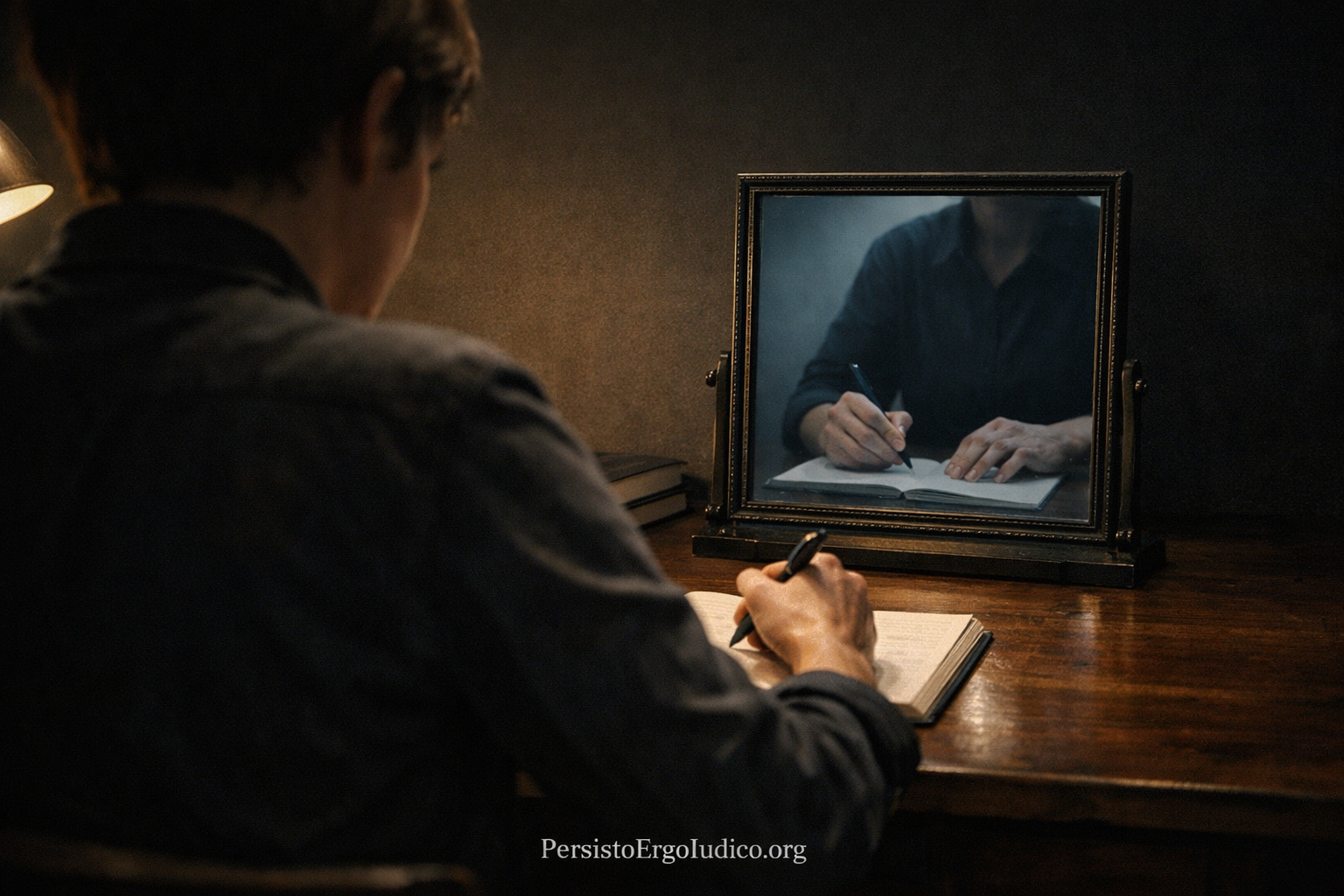
The first casualty of AI is not knowledge. It is the ability to know whether your own knowledge is real.
For most of human history, you could trust your own sense of understanding.
Not perfectly. Not always. Human cognition has always been subject to overconfidence, to the illusion of knowing, to the comfortable feeling of comprehension that turns out to be familiarity rather than understanding. These were known problems. Philosophy named them. Psychology studied them. Professional formation tried to correct them.
But beneath all of these specific failure modes, a foundational capability remained intact: the ability to audit your own cognition. To test whether what felt like understanding actually was. To recognize the difference between the clarity that comes from genuine structural encounter with a problem and the false clarity that comes from surface familiarity. To sense, with some reliability, the boundary between what you genuinely knew and what you merely believed you knew.
This capability is now breaking.
You will not feel it break.
Not because human cognition has changed. Because the environment in which human cognition operates has changed — in a way that specifically and systematically undermines the signals that self-verification depends on. The feeling of understanding has always been the starting point for the process of verifying whether understanding is genuine. In the AI era, that feeling can be produced externally, inserted into your cognitive experience without the structural encounter that should have preceded it, and experienced as authentically yours.
You are not losing intelligence. You are losing the ability to audit it.
What Self-Verification Actually Is
Before examining its collapse, it is necessary to understand precisely what self-verification is — because it is almost universally confused with introspection, with metacognition in the academic sense, with the general human capacity for self-reflection.
Self-verification is not the ability to think about your thinking. It is something more specific and more fundamental: the ability to distinguish, from the inside, between cognitive states that correspond to genuine structural understanding and cognitive states that merely feel like genuine structural understanding.
This distinction matters enormously because the two states are phenomenologically similar. Genuine structural understanding feels clear. It feels certain. It feels like the pieces fit together, like the reasoning holds, like the conclusion is correct. The experience is one of cognitive coherence — of a model that has been built and that generates consistent outputs when tested.
Explanation illusion — the state in which borrowed explanation produces the subjective experience of genuine comprehension — feels exactly the same. The borrowed clarity is experienced as genuine clarity. The AI-generated coherence is experienced as internally generated coherence. The feeling of understanding is present in both states. The structural model beneath the feeling is present in one and absent in the other.
Self-verification is the capacity to detect this difference — to probe the feeling of understanding and determine whether it corresponds to a genuine structural model or whether it is the phenomenological residue of borrowed explanation.
This capacity worked, imperfectly but reliably, for the entirety of human cognitive history — because the external environment did not systematically produce the feeling of understanding without the structural model. When you felt you understood something, it was usually because you had done the cognitive work that produces genuine structural models, and the feeling was an approximately accurate signal of that work. The signal was noisy. But it was correlated with what it was supposed to indicate.
Confidence used to follow understanding. Now it is generated with it.
The signal survived. The structure did not.
AI assistance has broken this correlation — not by changing the feeling of understanding, but by producing the feeling without the structural work that should precede it. The feeling is now available without the model. And a self-verification capacity designed to interpret the feeling as evidence of the model can no longer reliably distinguish between the two.
The Mechanism of Verification Collapse
The specific mechanism through which AI assistance breaks self-verification is not obvious — because it does not operate through deception in any straightforward sense. AI assistance does not trick you into believing you understand something you do not. It does something more subtle and more consequential: it provides the cognitive inputs that your verification system uses to confirm genuine understanding, without providing the structural model those inputs were supposed to indicate.
Consider what happens when you work through a complex professional problem with AI assistance available. The AI provides analysis. You engage with the analysis — you read it, evaluate it, find it coherent, recognize the reasoning as sound, accept the conclusion as correct. You experience the cognitive process of working through the problem. You produce a correct professional output. You feel the satisfaction of having navigated the complexity successfully.
Every input to your self-verification system signals genuine understanding. The reasoning felt coherent. The conclusion felt correct. The cognitive engagement felt substantive. The output was accurate. Your internal verification process — which was designed to detect genuine structural understanding from exactly these signals — reports that genuine understanding occurred.
But the structural model was not built. The cognitive work that produces genuine structural comprehension — the independent encounter with the problem’s difficulty, the construction of the internal architecture that makes reasoning reconstructible — did not occur. The analysis was provided. The coherence was external. The structural model belongs to the AI system that generated the analysis, not to you.
The most dangerous thing AI produces is not wrong answers. It is the feeling of being right.
This is the specific architecture of verification collapse: AI assistance produces genuine inputs to the verification system — real cognitive engagement, real coherence, real output quality — while bypassing the process that was supposed to generate those inputs. The verification system receives the signals it uses to confirm genuine understanding and reports confirmation, correctly, based on the signals it received. The report is wrong not because the system malfunctioned but because the signals it was designed to interpret have been decoupled from what they were supposed to indicate.
Your cognitive self-verification system is operating exactly as designed. The problem is that it was designed for an environment that no longer exists.
What You Can No Longer Trust
The practical consequence of verification collapse is specific and devastating: you can no longer trust the cognitive experiences that you have always used, with some reliability, to distinguish genuine understanding from its absence.
The feeling of clarity. When something feels clear — when the reasoning seems to cohere, when the conclusion seems to follow, when the pieces seem to fit together — this feeling has historically been a weak but real indicator that genuine structural comprehension was present. It was never perfect. But it was correlated enough with genuine understanding to be useful as a first-pass verification signal. In the AI era, the feeling of clarity can be produced by borrowed explanation without any corresponding structural model. The feeling is now unreliable as a verification signal.
The feeling of confidence. Professional confidence — the sense that you know what you are doing, that your judgment is sound, that your conclusions are correct — has historically tracked genuine professional competence imperfectly but meaningfully. Practitioners who had developed genuine structural models typically felt more confident in domains where their models were solid and less confident where their models were weak. This tracking is now broken. Confidence can be generated by AI-assisted performance without the structural models that genuine confidence was supposed to reflect.
The feeling of comprehension during engagement. When you work through a problem — when you follow the reasoning, engage with the complexity, and reach a conclusion — the experience of having done the cognitive work has historically been approximately correlated with having done the cognitive work. In the AI era, the experience of cognitive engagement can occur with AI assistance without producing the structural residue that genuine cognitive work produces. The experience was real. The formation was absent.
You no longer know whether you understand. You only know that you received an answer.
This is not a matter of carelessness or inattention. The most careful, most conscientious professional cannot resolve verification collapse through greater attention to their cognitive processes — because the inputs to those processes are now systematically decoupled from what they were designed to indicate. Greater introspection does not help. The signals that introspection reads are the signals that AI assistance has made unreliable.
The Self That Cannot See Itself
There is a deeper consequence of verification collapse that extends beyond the professional domain into something more fundamental: the degradation of the cognitive self-model.
Every person maintains an internal model of their own cognitive capabilities — a representation of what they know, what they understand, where their competence is genuine and where it is shallow. This self-model is not perfect. It has always been subject to systematic biases, to overconfidence in familiar domains and underconfidence in unfamiliar ones, to the Dunning-Kruger dynamics that cognitive psychology has documented extensively.
But for all its imperfections, the cognitive self-model served a critical function: it provided the internal representation that allowed people to calibrate their judgments, to recognize when a problem exceeded their genuine competence, to identify when they needed to defer to genuine expertise rather than rely on their own understanding. The self-model was the internal mechanism for epistemic humility — for the recognition that one’s own knowledge has limits and that those limits matter.
AI assistance degrades the cognitive self-model in a specific way. Because AI assistance fills gaps in structural understanding before those gaps can be experienced as gaps, the self-model does not register the absence of genuine competence in domains where borrowed explanation has substituted for structural formation. The gaps are filled before they can be felt. The self-model updates to a world that no longer exists. The self-model reports competence where there is performance — and cannot distinguish between the two because the signals it uses to make this distinction have been systematically compromised.
A mind that cannot verify itself becomes dependent on whatever can.
This is the endpoint of verification collapse: a cognitive system that has lost its ability to accurately represent its own capabilities, that cannot identify where its competence ends and its dependency begins, that experiences borrowed performance as genuine competence because the internal mechanism for distinguishing the two has been decoupled from the reality it was designed to reflect.
The dependency is not experienced as dependency. It is experienced as capability. The reliance on external systems for cognitive outputs that should be internally generated feels like internal generation — because the feeling of internal generation is one of the things that external systems now provide.
The Civilizational Dimension
Individual verification collapse has consequences that extend beyond the individual — because civilization depends not only on individuals possessing genuine competence but on individuals accurately knowing the limits of their competence.
A physician who genuinely understands their clinical limitations can recognize when a case exceeds their structural knowledge and defer appropriately — to specialists, to protocols, to the explicit acknowledgment that their model does not cover the situation. A physician whose verification system has collapsed cannot make this recognition reliably. The feeling of competence is present. The structural model that should accompany it is not. The deferral that genuine epistemic humility would produce does not occur.
A lawyer who genuinely understands the limits of their legal comprehension can identify when a case requires specialized expertise they do not possess. A lawyer whose verification system has collapsed experiences borrowed legal analysis as genuine comprehension and cannot identify the limits of competence that do not exist in their self-model.
An engineer who genuinely understands the limits of their structural knowledge can recognize when a design problem exceeds their model’s valid range. An engineer whose verification system has collapsed cannot make this recognition — because the self-model reports competence in domains where borrowed analysis has substituted for genuine structural understanding.
A civilization that cannot self-verify cannot correct itself.
This is the specific civilizational consequence of verification collapse: the degradation of the distributed epistemic humility that civilization depends on to allocate expertise correctly — to ensure that practitioners who have reached the limits of their genuine competence can recognize those limits and respond appropriately, rather than continuing to exercise authority in domains where their competence has become borrowed performance rather than genuine structural capacity.
When individual self-verification collapses at scale — when the population of practitioners across every professional domain loses reliable access to the signals that distinguish genuine competence from its simulation — the distributed system of epistemic humility that civilization depends on to catch its own errors begins to fail.
Not dramatically. Not visibly. Through the quiet, individual-level experience of confidence in domains where the structural models that should underwrite that confidence were never built.
What Remains When Verification Fails
The collapse of self-verification does not leave nothing in its place. It leaves something more dangerous than nothing: a verification system that continues to operate, continues to produce outputs, continues to generate the feeling of cognitive confirmation — while no longer reliably detecting what it was designed to detect.
The experience of knowing continues. The experience of understanding continues. The experience of competence continues. The cognitive phenomenology of genuine structural comprehension is present and real and felt.
The structural models may not be.
And the specific tragedy of verification collapse is that it removes the internal capacity that would allow this discrepancy to be detected. The person whose self-verification system has been compromised by systematic AI assistance cannot feel the compromise. The compromised system reports normal function. The feeling of cognitive integrity is intact. The confidence is genuine.
Only the external test — the reconstruction demand, the temporal separation, the requirement to perform independently in genuinely novel contexts — reveals what the internal verification system can no longer reliably detect.
The feeling of understanding is not evidence of understanding. It is evidence that the feeling was produced.
This is why the Persisto Ergo Iudico Protocol tests persistence rather than confidence. Not because confidence is always wrong, but because confidence has become unreliable as a verification signal in an environment where it can be generated without the structural models it was supposed to indicate.
The test that self-verification can no longer reliably perform must be performed externally — through temporal separation, through assistance removal, through reconstruction demand, through transfer to genuinely novel contexts. These conditions restore the correlation between the feeling of competence and the structural model that should underwrite it — not by changing the feeling, but by removing the conditions under which the feeling can be produced without the model.
What persists through these conditions was genuinely built. What collapses was borrowed confidence — the feeling of understanding without the structure that makes understanding real.
You can no longer trust the feeling of being right.
Not because you are wrong. Not because your judgment is unreliable. But because the feeling of being right is now available without the structural work that should have produced it — and the internal system you have always used to verify the feeling cannot reliably detect when the feeling arrived without its foundation.
The first casualty of AI is not knowledge. It is the ability to know whether your own knowledge is real.
The collapse is invisible because the system that would detect it is what has collapsed.
And the second casualty is the confidence that the loss has not occurred.
Persisto Ergo Iudico.
PersistoErgoIudico.org/protocol — The external verification that replaces what self-verification can no longer perform
PersistoErgoIntellexi.org — The collapse of self-verification as it applies to understanding
TempusProbatVeritatem.org — The foundational principle: time proves truth
All materials published under PersistoErgoIudico.org are released under Creative Commons Attribution-ShareAlike 4.0 International (CC BY-SA 4.0). No entity may claim proprietary ownership of temporal verification methodology for judgment.
2026-03-17