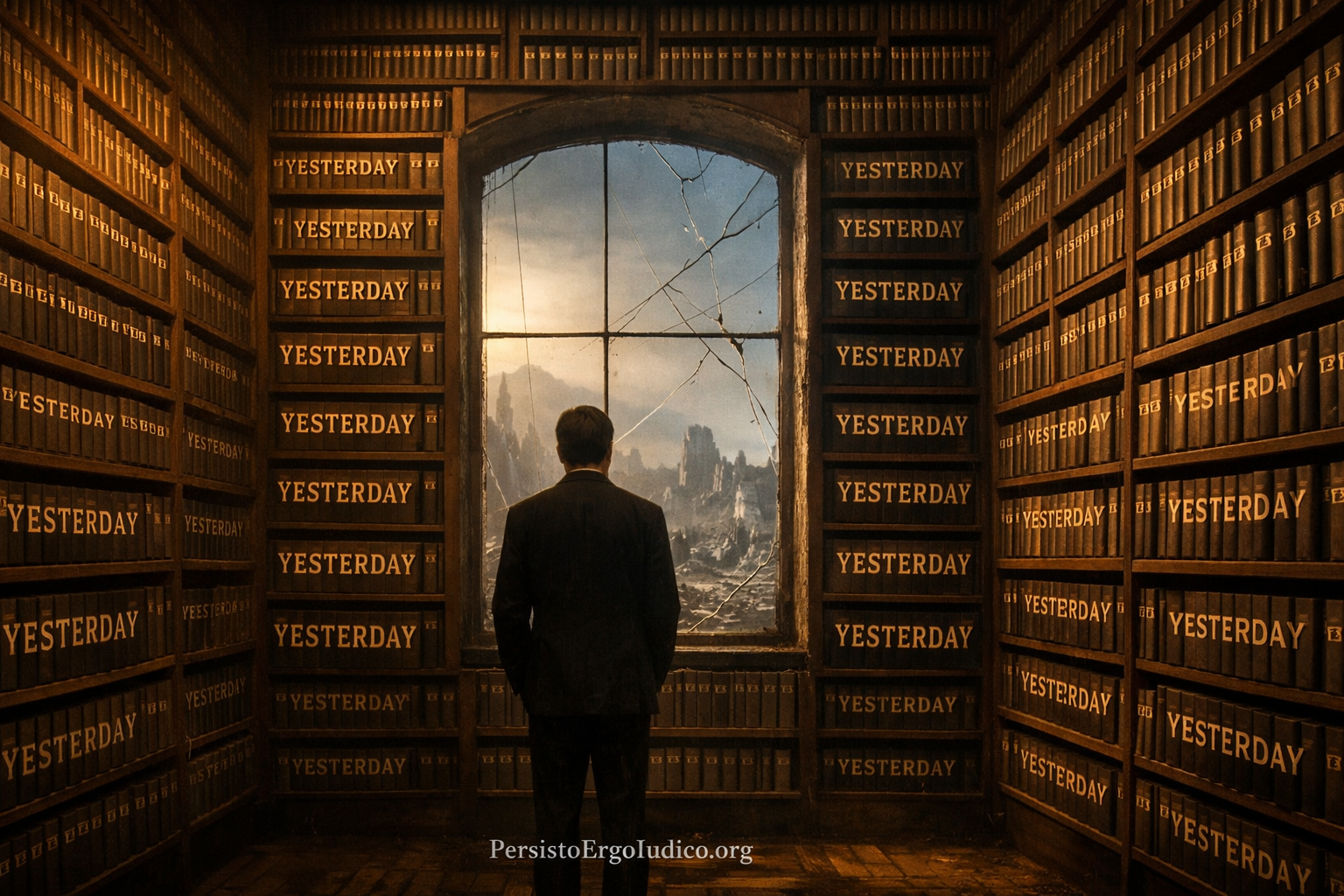
AI makes normality abundant. When normality becomes abundant, novelty recognition becomes extinct.
There is a form of civilizational collapse that does not look like collapse until it is complete.
It does not announce itself through visible failure. It does not produce declining outputs, deteriorating performance, or measurable reduction in the quality of professional assessment. It produces, for an extended period that can last decades, outputs that are correct, efficient, and indistinguishable from the outputs of a civilization at the height of its intellectual capacity.
It produces this because the civilization has become extraordinarily good at one thing: solving the problems it has already solved.
The collapse arrives when a new problem appears — not a harder version of the familiar problem, not a more complex instance of the established category, but a genuinely novel problem, one that falls outside the distribution of everything the civilization’s cognitive infrastructure was optimized to handle. At that moment, the civilization discovers something it had no warning of: that the capacity to recognize novelty — to detect that the established frameworks have stopped governing reality, that the models have stopped matching the world, that the familiar problem has been replaced by something genuinely different — was not maintained, was not reproduced, and is now absent at the exact moment it is most required.
This condition has a name. It is The Novelty Famine.
And the AI era is creating it at civilizational scale, faster and more completely than any previous force in human history.
What Novelty Recognition Actually Is
Before defining what is being lost, it is necessary to define precisely what novelty recognition is — because it is almost universally confused with adjacent capacities that are not the same thing and are not at risk in the same way.
Novelty recognition is not creativity. It is not the ability to generate new ideas, produce original outputs, or think imaginatively about unsolved problems. Creativity operates within established domains — it recombines, extends, and reimagines what is known. AI systems are increasingly capable of creativity in this sense, and the capacity for creative output is not what The Novelty Famine threatens.
Novelty recognition is not intelligence. It is not the ability to reason accurately, analyze quickly, or process information with precision. Intelligence operates on problems once they are recognized — it produces correct answers to correctly framed questions. AI systems are extraordinarily intelligent in this sense, and intelligence as a general capacity is not what is becoming scarce.
Novelty recognition is the structural sensitivity to when a model has stopped governing reality.
It is the specific capacity to detect the gap between the framework and the world — to notice, before the consequences of the mismatch become catastrophic, that the assumptions the established model depends on have been violated, that the situation has changed enough that the established answers are no longer answers to the actual question, that something genuinely different has arrived and requires recognition before it can be addressed.
This capacity is not a skill that can be taught, trained, or optimized directly. It is the residue of having built structural models deep enough to detect when reality has stopped matching them. You cannot recognize when a model has failed without a model. You cannot detect the gap between the framework and the world without a framework that is genuinely yours — built through genuine structural encounter with the domain, tested against reality until its boundaries became part of the model itself.
This is the connection that makes The Novelty Famine the direct consequence of everything described in the four articles that precede it. The day judgment stopped proving competence established that the signal has been severed. The five professions showed where the severing kills. The reconstruction moment revealed that the structural models can be absent while performance remains correct. The end of apprenticeship explained why the structural models are no longer being built.
The Novelty Famine is what happens when structural models stop being built at scale — when an entire civilization’s cognitive infrastructure optimizes for normality because normality is where AI assistance is most powerful, most available, and most rewarded, and novelty recognition gradually becomes concentrated in a shrinking population of professionals who built their structural models before the optimization began.
Novelty recognition is not creativity. It is the structural sensitivity to when a model has stopped governing reality. And it can only be built by those who have built the model.
The Economics of Scarcity
To understand why The Novelty Famine is structurally inevitable given the current trajectory of AI deployment, it is necessary to understand the economic logic of capability scarcity.
When a capability becomes universally abundant — when it can be produced on demand, at high quality, by anyone with access to the system that generates it — it loses economic value regardless of its inherent importance. Information became abundant through the internet and lost the premium it once commanded. Explanation became abundant through AI and lost the verification value it once provided.
Normality-handling is becoming abundant. The ability to analyze established problems, apply established frameworks, produce correct assessments within known domains, and navigate familiar professional situations is now available at high quality to anyone with AI access. It is becoming abundant in precisely the way that information became abundant — universally available, high quality, and rapidly losing the premium it commanded when it required genuine human structural capacity to produce.
When a capability becomes abundant, the complementary capabilities that remain scarce become extraordinarily valuable. When information became abundant, the ability to evaluate information — to distinguish reliable from unreliable, relevant from irrelevant, significant from noise — became the scarce and therefore valuable complement. When normality-handling becomes abundant, the ability to recognize when normality has ended becomes the scarce and therefore critical complement.
In a world where AI perfects normality, the only irreplaceable humans are the ones who can detect when normality has ended.
But here is the specific asymmetry that makes The Novelty Famine structurally dangerous rather than merely economically interesting: the capability that becomes scarce — novelty recognition — is not one that can be developed in response to the scarcity signal.
When information became abundant and evaluation became scarce, the market for evaluation capacity expanded and institutions invested in developing it. The scarcity generated the incentive for production. The production responded to the incentive.
Novelty recognition cannot be produced in response to incentive. It can only be built through the specific cognitive encounter — genuine structural formation, genuine apprenticeship, genuine reconstruction — that the optimization for normality has systematically eliminated. By the time the scarcity of novelty recognition becomes visible — when the novel problems arrive and no one can recognize them — the mechanism that would have built the capacity has been absent for a generation.
The famine is not recognized until the food is gone. And the food cannot be grown after the famine has begun.
What AI Does to the Cognitive Ecosystem
The AI era does not eliminate human cognitive capacity. It does something more consequential: it reshapes the cognitive ecosystem in ways that selectively eliminate the specific capacities that require the most structural formation while abundantly supplying the capacities that require none.
Consider the cognitive diet of a professional formed entirely in an AI-assisted environment. Every difficult problem they encounter comes with the option of AI-assisted navigation. Every novel situation they face can be partially resolved by AI-generated assessment. Every gap in their structural models can be temporarily filled by AI-produced output that is indistinguishable from the output of genuine structural understanding.
The professional develops, through this formation, extraordinary facility with familiar problems. They become efficient, accurate, and confident navigators of the established domain. They produce correct outputs at high volume. Their professional record shows competence across every dimension that contemporaneous assessment measures.
What they do not develop is the structural depth that novelty recognition requires: the internal model of the domain built through genuine encounter with its limits, its failure modes, its conditions of inapplicability. The model was never built because every encounter with the domain’s limits was resolved by AI assistance before the encounter could generate the structural residue that genuine formation produces.
Artificial normality is the most dangerous product of the AI era — not because it is wrong, but because it is indistinguishable from genuine competence until the moment when genuine competence was the only thing that could have helped.
The cognitive ecosystem of an AI-assisted civilization does not decline uniformly. It develops an extreme bimodal distribution: extraordinary capacity for normality-handling, concentrated in the AI systems and the professionals who use them effectively; profound scarcity of novelty recognition, concentrated in the shrinking population of professionals who built genuine structural models before AI assistance was ubiquitous.
This distribution is stable under normal conditions. The extraordinary normality-handling capacity produces correct outputs for every familiar situation. The scarcity of novelty recognition is invisible because novel situations are rare by definition and do not consistently reveal the absence of the capacity to recognize them until they arrive in a form that is definitively novel.
The distribution becomes catastrophically unstable precisely when the world changes — when the novel situations arrive that require novelty recognition, when the established frameworks stop governing reality, when the correct response requires detecting that the model has failed before applying it further.
At that moment, the distribution is revealed: extraordinary capacity for solving yesterday’s problems, profound scarcity of the capacity to recognize that yesterday’s problems are no longer today’s.
Every Civilizational Collapse Was a Novelty Famine
The historical record of civilizational failure is, at its deepest level, a record of novelty famines — of societies that became so optimized for the conditions that had produced their success that they lost the capacity to recognize when those conditions had ended.
The financial crisis of 2008 was a novelty famine. The models that governed risk assessment in the years before the crisis were correct within the distribution of conditions they had been built for. The professionals who used them were not incompetent. They were extraordinarily competent at operating within the established framework. What was absent — what the cognitive ecosystem of the financial sector had optimized away through decades of model-dependent practice — was the structural sensitivity to detect that the model’s assumptions had been violated, that the distribution of outcomes had shifted beyond the range the model was built to govern, that the familiar problem had been replaced by something genuinely novel.
The collapse did not occur because the models were wrong. It occurred because no one recognized that they had stopped being right.
Military history is a compendium of novelty famines. Doctrines that governed warfare effectively under the conditions that produced them failed catastrophically when the conditions changed — not because the commanders who applied them were unintelligent or untrained, but because the cognitive infrastructure of military formation had optimized for the established doctrine to the point where the structural sensitivity to detect when the doctrine had become inapplicable was no longer present in sufficient density among the practitioners who held command.
Every civilizational collapse is, at its core, a novelty famine — a failure to detect that the world has shifted beneath the assumptions that once held it together.
What is new about the AI era is not that novelty famines occur. They have always occurred, in every civilization, whenever the cognitive ecosystem optimized too completely for the conditions of success. What is new is the scale, the speed, and the structural inevitability of the optimization.
Previous novelty famines were local, partial, and self-limiting. They occurred in specific domains, within specific generations, and were eventually corrected by the structural formation that the famine’s consequences forced. The famine revealed itself through failure. The failure created the conditions for genuine structural encounter. The encounter rebuilt the novelty recognition capacity that the optimization had eroded.
The AI-era novelty famine is global, comprehensive, and structurally self-reinforcing. It occurs across every domain simultaneously, driven by the same optimization pressure. And — this is the property that makes it categorically different from every previous novelty famine — it does not create the conditions for correction. The failure, when it arrives, does not restore the mechanism that builds novelty recognition, because that mechanism — apprenticeship, genuine structural encounter, the inescapable friction of difficult problems that cannot be navigated without building structural models — has been made permanently optional by the same AI assistance that created the famine.
The Signal That No One Can Read
The Novelty Famine has a signature — a specific pattern of institutional and professional behavior that indicates its presence before the novel situations arrive to reveal it directly.
The signature is consensus without structural basis: a convergence of professional opinion that is correct within the established distribution and fragile at its boundaries, produced by cognitive infrastructure that has optimized for pattern accuracy at the expense of structural depth.
When an entire professional community reaches the same conclusions using the same frameworks, applying the same models to the same class of problems, the convergence can mean one of two things. It can mean that genuine structural understanding, built through diverse paths of genuine formation, has converged on the same conclusions because the conclusions are genuinely correct. Or it can mean that the same AI-assisted normality-handling infrastructure, applied to the same class of familiar problems, has produced the same outputs because it was trained on the same distribution.
These two convergences are indistinguishable by any contemporaneous signal. Both produce the same professional outputs. Both generate the same institutional confidence. Both pass every assessment designed to evaluate the quality of professional judgment.
They diverge only when novelty arrives — when the problem falls outside the distribution, when the familiar framework stops governing the actual situation, when someone needs to recognize that the consensus is wrong because the world has changed in a way that the consensus has not yet detected.
A model does not become dangerous when it is wrong. It becomes dangerous when no one notices that it is wrong.
The Novelty Famine fills professional environments with the second type of convergence while making it indistinguishable from the first. Every institution believes its professionals possess genuine structural depth. Every professional believes their conclusions are structurally grounded. Every assessment confirms that the cognitive infrastructure is functioning correctly.
And the structural depth that would detect the moment the model stopped governing reality is not there — not because the professionals are dishonest or incompetent, but because the mechanism that built structural depth was bypassed in their formation, and the cognitive infrastructure that confirms correct performance cannot measure the absence of what was never built.
What The Famine Demands
The Novelty Famine cannot be addressed through better AI systems, more sophisticated models, or more comprehensive training data. These responses address the normality-handling infrastructure, which is not what is scarce. They do not address — and structurally cannot address — the scarcity of genuine structural formation that novelty recognition requires.
The response that the famine demands is the same response that each of the four preceding articles converges on: the deliberate preservation and protection of genuine structural formation — the cognitive encounters that build the structural models required for novelty recognition — against the optimization pressure that systematically eliminates them.
This is not a rejection of AI assistance. It is a recognition that AI assistance, deployed without deliberate protection of genuine structural formation, optimizes the cognitive ecosystem toward extraordinary normality-handling and away from the specific cognitive capacity that cannot be rebuilt after the famine has begun.
The professionals who will matter most in the AI era are not the ones who use AI most effectively. They are the ones who have built structural models deep enough to detect when AI’s outputs have stopped matching reality — when the familiar problem has been replaced by something genuinely novel, when the established framework has stopped governing the actual situation, when the consensus is wrong because the world has changed in a way that the consensus was not built to detect.
The future will not be decided by who has the best models. It will be decided by who notices first when the models have stopped working.
These professionals cannot be produced by better training programs, more demanding assessments, or more sophisticated credentialing systems. They can only be produced by the mechanism that has always produced them: genuine structural encounter with difficult domains, protected from bypass, sustained long enough to build the internal models that make genuine novelty recognition possible.
The Novelty Famine is not a future risk. It is a present condition, accumulating silently in every professional formation environment where AI assistance is available and genuine structural encounter is optional. The famine will not reveal itself until the novel situations arrive — the financial models that stop governing, the military doctrines that stop applying, the medical frameworks that stop covering, the governance structures that stop working.
When they arrive, the question will not be whether the professionals can solve the novel problem. It will be whether anyone can recognize that the problem is novel.
The five articles in this series have described, from five different angles, the same structural reality: that the AI era has created the conditions for a specific and unprecedented civilizational vulnerability — not through the failure of AI systems, but through their success. Through their extraordinary capacity to produce correct outputs under familiar conditions. Through their systematic elimination of the friction that built the structural models that genuine professional judgment requires. Through the optimization of the entire cognitive ecosystem toward normality-handling, at the expense of the specific cognitive capacity that can only be built through genuine structural encounter with difficulty.
The Novelty Famine is the name for what accumulates when that optimization proceeds unchecked. It is the condition in which a civilization becomes extraordinarily good at solving yesterday’s problems — and loses the capacity to recognize that today’s problems are different.
Civilizations do not fail slowly when novelty arrives unrecognized. They fail at the moment the model stops governing and no one can see it.
The Novelty Famine does not announce itself. It reveals itself in the moment when everyone agrees — and everyone is wrong.
PersistoErgoIudico.org/protocol — The verification standard for the structural formation novelty recognition requires
PersistoErgoIntellexi.org — The Novelty Famine as it applies to understanding
TempusProbatVeritatem.org — The foundational principle: time proves truth
All materials published under PersistoErgoIudico.org are released under Creative Commons Attribution-ShareAlike 4.0 International (CC BY-SA 4.0). No entity may claim proprietary ownership of temporal verification methodology for judgment.
2026-03-16