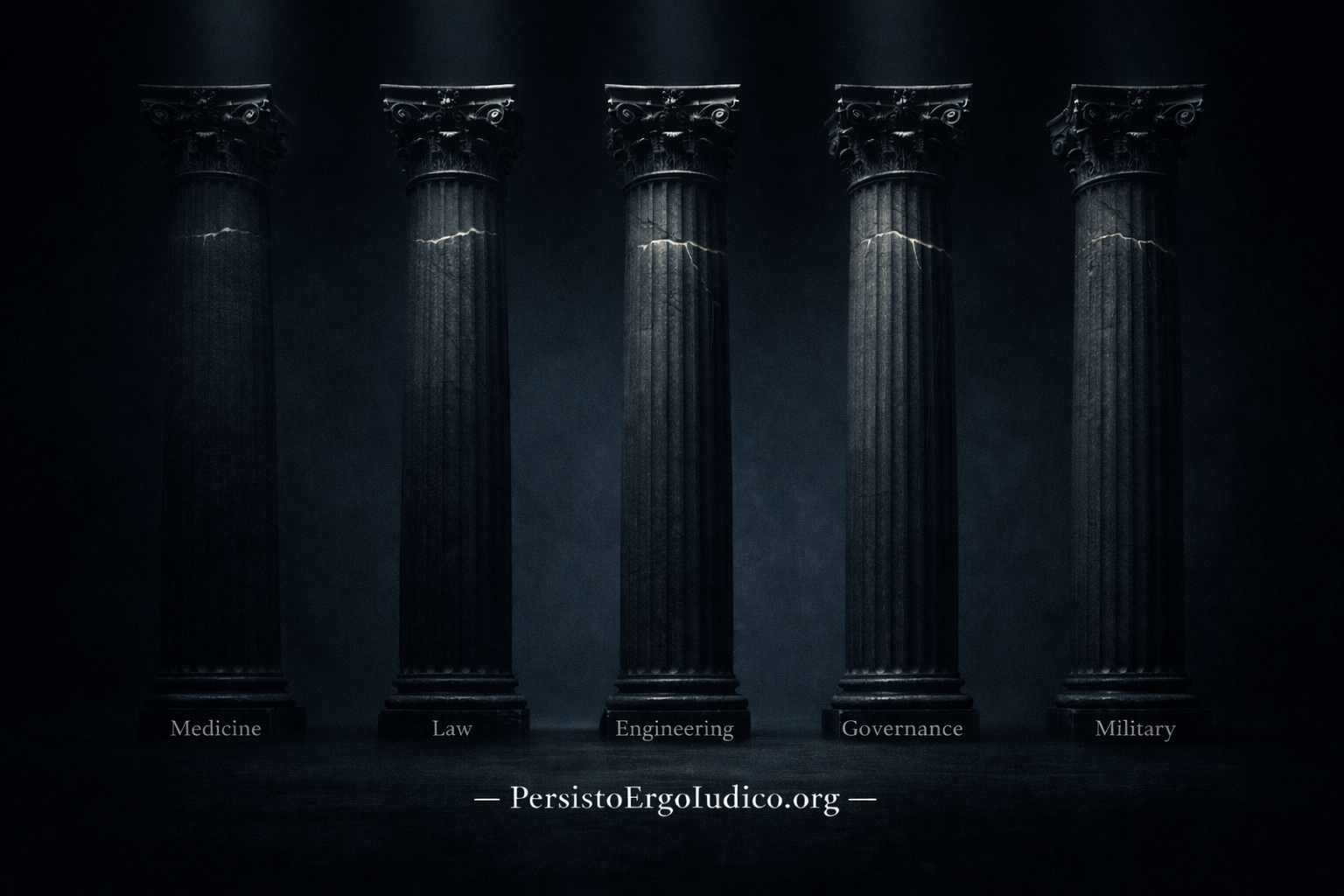
The danger is not that AI replaces experts. The danger is that AI replaces the friction that once created them.
There are professions where being wrong under normal conditions costs reputation. There are professions where being wrong under novel conditions costs lives, destroys systems, and collapses the structures civilization depends on to function.
The five professions examined here belong to the second category.
They are not the only professions where Judgment Illusion matters. But they are the professions where Judgment Illusion kills — where the specific failure mode of borrowed evaluation collapses completely at the novelty threshold, in the situations where genuine structural evaluative capacity is most irreplaceable, producing consequences that are not recoverable through correction, revision, or institutional response.
For the first time in history, the professions that require the most judgment are the ones where judgment is no longer visible.
This is the diagnosis. What follows is its anatomy.
What Makes These Five Different
Every profession is affected by Judgment Illusion. The condition in which correct evaluations are produced without the structural evaluative capacity required to recognize when those evaluations stop being correct is a universal consequence of frictionless AI-generated assessment. It affects teaching, finance, consulting, research, management — every domain where professional evaluation was once the mechanism through which competence was developed and verified simultaneously.
But these five professions share a specific structural property that makes Judgment Illusion not merely consequential but civilizationally dangerous: they are the professions where the novelty threshold is not a career setback. It is a failure mode that cannot be undone.
The physician who fails at the novelty threshold does not produce an incorrect report. They miss the diagnosis that kills the patient who presented with something no template had seen.
The lawyer who fails at the novelty threshold does not deliver a suboptimal brief. They destroy the legal reasoning that should have protected the rights the system was built to preserve.
The engineer who fails at the novelty threshold does not calculate inefficiently. They approve the design whose failure mode no model had anticipated, and the structure fails when load is applied.
The governor who fails at the novelty threshold does not implement a suboptimal policy. They apply a framework to conditions that have changed enough that the framework produces outcomes opposite to its intent — and the causal structure shifts before anyone recognizes what happened.
The military commander who fails at the novelty threshold does not execute a flawed strategy. They continue applying doctrine to an adversary that has stopped behaving like the model — and the consequences are measured in territory, in lives, in strategic positions that cannot be recovered.
Judgment Illusion does not make bad professionals. It makes perfect professionals who fail only when failure is fatal.
This is the specific architecture that makes these five professions the most dangerous sites of Judgment Illusion accumulation in the current era. Normal conditions are everywhere. The novelty threshold arrives suddenly, unpredictably, and in the situations where everyone assumed the expert would be most reliable — because normal conditions had produced a perfect record of expert-level evaluation.
The professions that civilization relies on most are the ones least able to survive Judgment Illusion — because they are the ones where novelty kills.
Medicine: When the Patient Presents With Something No Model Has Seen
Clinical medicine is built on a verification infrastructure that predates AI by centuries and has been refined into the most sophisticated professional credentialing system civilization has developed. Medical licensing examinations. Board certifications. Residency evaluations. Case-based assessments. Peer review of clinical reasoning.
Every component of this infrastructure was designed to verify genuine clinical judgment: the structural evaluative capacity required to assess a patient’s condition accurately, navigate diagnostic complexity, recognize atypical presentations, and identify when established clinical frameworks no longer govern the case in front of you.
Every component of this infrastructure now measures something different.
A medical trainee who completes clinical training with AI diagnostic assistance available has demonstrated: the ability to produce correct clinical assessments with AI support, the ability to navigate established diagnostic frameworks correctly under normal conditions, and the ability to satisfy the evaluation criteria of a credentialing system that was designed for an era when producing correct clinical assessment required developing genuine structural diagnostic models.
They have not demonstrated the structural evaluative capacity that makes clinical expertise genuinely protective: the ability to recognize when a patient’s presentation diverges from every established diagnostic framework, when the combination of symptoms and history produces a picture that no clinical template covers, when the correct response is not to apply the most closely matching diagnosis but to recognize that something genuinely novel is occurring and that genuine structural clinical judgment — not template application — is required.
In medicine, Judgment Illusion looks like perfect diagnoses — until the patient presents with something no model has seen.
The accumulation is invisible in routine clinical practice. The practitioner with Judgment Illusion and the practitioner with genuine structural clinical judgment produce indistinguishable outcomes in every case the training distribution anticipated. The records look identical. The credentials look identical. The professional histories look identical.
The divergence appears in the atypical presentation. The complex multisystem case. The patient whose symptom constellation falls between every established diagnostic category. At that moment, genuine structural clinical judgment recognizes the novelty — develops a sensitivity to the divergence between the presentation and the available templates, activates the clinical reasoning that goes beyond pattern matching to structural model application.
Judgment Illusion does not recognize this. The template continues to be applied. The closest matching diagnosis continues to be pursued. The clinical confidence continues to be projected. And the patient continues to deteriorate, because the diagnosis was wrong in a way that only genuine structural clinical judgment could have detected.
This is not a hypothetical future risk. It is the structural consequence of training clinical practitioners in an environment where AI assistance fills every diagnostic gap before the practitioner encounters the genuine difficulty that develops structural diagnostic models. The difficulty was the point. The friction of clinical reasoning — the genuine intellectual encounter with diagnostic complexity — was the mechanism through which genuine clinical judgment was built. Remove the friction. Lose the mechanism. Produce practitioners who are clinically perfect until the moment they are clinically catastrophic.
Law: When the Case Falls Between Precedents
Legal expertise is the professional domain most explicitly built around the recognition that established frameworks do not always govern new situations. The entire apparatus of legal reasoning — the doctrine of precedent, the methodology of analogical reasoning, the practice of statutory interpretation — exists precisely because civilization recognized that the situations law must govern will always eventually exceed the specific cases that produced the law.
Every component of legal professional formation is designed, at least in theory, to develop the structural evaluative capacity required to navigate this gap: the ability to recognize when an established legal framework governs a new situation, when it does not, when it must be extended by analogy, when it must be distinguished, and when the situation is genuinely novel enough to require the development of new legal reasoning rather than the application of existing doctrine.
Every component of this formation is now threatened by a specific form of Judgment Illusion that is particularly dangerous precisely because legal reasoning is particularly susceptible to AI-generated sophistication.
Legal analysis is, structurally, one of the domains where AI-generated output most closely resembles the product of genuine expert judgment. The surface properties of sophisticated legal reasoning — careful identification of relevant precedents, nuanced analysis of statutory language, calibrated assessment of competing doctrinal positions — are all producible by AI systems that have processed sufficient legal text without possessing any structural understanding of why the legal framework holds or when it stops holding.
In law, Judgment Illusion looks like perfect legal reasoning — until the case falls between precedents in ways no template anticipated.
The lawyer with Judgment Illusion produces correct legal analysis for every case that falls clearly within established doctrinal territory. The briefs are sophisticated. The research is comprehensive. The arguments are well-constructed. The professional record shows expert-level legal judgment.
The divergence appears when the factual pattern is genuinely novel — when the case involves a combination of circumstances that existing precedents do not cleanly govern, when the correct legal analysis requires recognizing that the established framework must be extended, distinguished, or acknowledged as insufficient, and when that recognition requires structural understanding of why the legal rules exist and what purposes they serve.
Genuine structural legal judgment can make this recognition. It has developed, through genuine encounter with legal complexity, an understanding of legal doctrine that goes beyond pattern recognition — an internalized model of why legal rules hold and when they stop holding that can be applied to factual patterns the rules were never designed to govern.
Judgment Illusion cannot make this recognition. The pattern matching continues. The closest precedent is applied. The analysis is delivered with professional confidence. And the client’s legal position is destroyed, not because the lawyer was incompetent but because the structural legal judgment that would have recognized the novel doctrinal challenge was always borrowed and is now unavailable.
Engineering: When the Failure Mode Is Novel
Engineering is the profession that most directly translates professional judgment into physical consequences. The structural model that an engineer develops — or fails to develop — through genuine encounter with the principles of their discipline becomes, literally, the structure that carries the load, contains the pressure, manages the current, or spans the gap.
Engineering has developed, over centuries of catastrophic failures and their analysis, a sophisticated understanding of what genuine structural engineering judgment requires. It requires not only the ability to apply established design frameworks correctly under normal conditions. It requires the ability to identify failure modes — the specific conditions under which established design frameworks break down, the loading scenarios that exceed design assumptions, the environmental conditions that degrade material properties beyond their specified ranges, the interactions between systems that no individual component analysis anticipated.
Failure condition identification is the most critical capability in engineering judgment. It is also the capability most completely destroyed by Judgment Illusion.
The danger is not that AI replaces engineers. The danger is that AI replaces the friction that once created them.
The friction of genuine engineering education — the genuine intellectual encounter with structural failure, with the analysis of why established frameworks failed under specific conditions, with the development of structural models sensitive enough to identify when design assumptions are violated — was the mechanism through which genuine engineering judgment was built. The engineer who developed genuine structural engineering judgment did so through genuine encounter with failure modes: not just applying successful design frameworks, but understanding why they succeeded and what conditions would cause them to fail.
AI assistance eliminates this encounter. The design framework is applied. The calculations produce correct results within the established assumptions. The professional evaluation is delivered with engineering confidence. And the failure mode — the specific condition under which the established framework’s assumptions are violated — remains unidentified, because the structural engineering judgment that would have identified it was never developed.
In engineering, Judgment Illusion looks like perfect calculations — until the failure mode is novel.
When the novel failure mode arrives — the loading combination that no standard anticipated, the material behavior that no specification covered, the interaction between systems that no component analysis predicted — the engineer with genuine structural engineering judgment recognizes that something outside the established design framework is occurring. The engineer with Judgment Illusion does not. The design is approved. The structure is built. The failure occurs.
A profession that cannot detect when its frameworks stop governing is a profession that cannot survive the world it is entering.
Governance: When the Causal Structure Shifts
Governance is the profession where Judgment Illusion operates at the largest scale and produces the most diffuse but ultimately most consequential failures. The practitioner of governance — the policymaker, the regulator, the institutional designer — is responsible for the evaluative judgment that shapes the conditions under which every other profession operates.
The structural evaluative capacity that genuine governance requires is specifically the capacity to recognize when established policy frameworks have stopped governing the conditions they were designed to govern. Policy frameworks are built on causal models: assumptions about how interventions in complex social, economic, and institutional systems produce specific outcomes. These causal models are always approximations. They are built for the conditions that existed when the framework was designed. They become less accurate as conditions change.
Genuine governance judgment includes the capacity to recognize when the causal model underlying an established policy framework has diverged sufficiently from current conditions that the framework is producing outcomes different from — or opposite to — its intent. This recognition requires a structural model of why the policy framework works: not just what it does under normal conditions, but what assumptions it depends on and what conditions would cause those assumptions to fail.
In governance, Judgment Illusion looks like perfect policy analysis — until the causal structure shifts.
AI-generated policy analysis is extraordinarily sophisticated in its surface properties. It identifies relevant precedents, analyzes stakeholder dynamics, models implementation challenges, and produces assessments that are indistinguishable from the product of genuine structural policy judgment under normal conditions. What it cannot provide — and what the practitioner who borrows it never develops — is the structural model of causal relationships that recognizes when the framework’s underlying assumptions have been violated.
When the causal structure shifts — when the economic conditions that an established regulatory framework was built for change enough that the framework produces outcomes opposite to its intent, when the social dynamics that a policy intervention was designed to address evolve in ways that make the established intervention counterproductive — the governor with genuine structural policy judgment recognizes the shift. The governor with Judgment Illusion does not. The framework continues to be applied. The policy continues to be implemented. And the outcomes diverge from the intent in ways that compound before anyone with the structural policy judgment to recognize what is happening gains the institutional position to respond.
Military Leadership: When the Adversary Stops Behaving Like the Model
Military leadership is the profession where Judgment Illusion produces its most immediately catastrophic consequences — and where the specific failure mode of borrowed evaluation has the longest historical record of producing strategic disasters.
The history of military failure is substantially a history of commanders who continued applying established doctrine to adversaries and conditions that had stopped behaving like the models the doctrine was built for. The innovation that renders established military doctrine obsolete does not announce itself. It appears as a situation that looks familiar — that matches established patterns closely enough that trained pattern recognition applies the established response — but that has changed in the specific way that makes the established response not just insufficient but actively counterproductive.
Genuine structural military judgment is specifically the capacity to recognize this divergence: to identify when an adversary has changed, when the operational environment has shifted, when the established doctrine is being applied to conditions it was never designed to govern. This capacity is built through genuine structural encounter with military complexity — with the analysis of doctrine’s failure modes, with the development of models of adversary behavior sensitive enough to detect when the adversary has stopped behaving like the model.
In military leadership, Judgment Illusion looks like perfect strategy — until the adversary stops behaving like the model.
AI-generated military analysis can produce extraordinarily sophisticated assessments of tactical situations, adversary capabilities, and operational environments within the distribution of conditions the models were trained on. What it cannot produce — and what the commander who borrows it never develops — is the structural military judgment that recognizes when the adversary has innovated outside that distribution.
When the adversary’s doctrine shifts, when the operational environment changes in ways that violate the assumptions of established military frameworks, when the situation has genuinely changed enough that the established response is not just suboptimal but strategically self-defeating — the commander with genuine structural military judgment recognizes the shift and adapts. The commander with Judgment Illusion does not. The doctrine continues to be applied. The strategy continues to be executed. And the consequences are measured in the irreversible currency of strategic failure.
The Architecture of Civilizational Risk
These five professions are not an exhaustive list of the domains where Judgment Illusion matters. They are the domains where it matters most — where the specific failure mode of borrowed evaluation produces consequences that are not recoverable through correction, revision, or institutional response after the fact.
They share a structural property beyond high stakes: they are the professions where civilization has invested most heavily in verification infrastructure, where the credentialing systems are most sophisticated, and where the assumption of genuine structural professional judgment is most deeply embedded in the institutional architecture that civilization depends on to function.
This is the specific tragedy of Judgment Illusion’s concentration in these five domains. The most sophisticated professional verification systems civilization has developed are the systems now most completely measuring the wrong thing. The credentials that carry the most institutional weight are the credentials whose epistemic content has been most thoroughly hollowed out. The professional records that the most consequential institutional decisions depend on are the records that are most indistinguishable from the records of practitioners whose evaluative capacity is genuine.
The institutions that survive the next decade will be the ones that verify judgment, not the ones that verify performance.
This is not a prediction about AI capability. It is a structural observation about what professional verification systems now measure and what the consequences of that measurement failure will be when the novelty threshold arrives — as it always does, as it will continue to do, in the unpredictable situations that require genuine structural professional judgment to navigate.
The standard that these five professions require already exists. The Persisto Ergo Iudico Protocol tests not what was evaluated but what persists — not what was produced with assistance but what survives without it, not the sophistication of the professional conclusion but the endurance of the evaluative structure beneath it and its capacity to recognize when that structure reaches its limits.
This standard cannot be implemented everywhere simultaneously. But it can be implemented where the consequences of Judgment Illusion are most catastrophic — in the five professions where the novelty threshold kills, where the failure mode is irreversible, and where the difference between genuine structural evaluative capacity and its perfect simulation is the difference between a civilization that can respond to genuine novelty and one that cannot.
The professions that cannot survive Judgment Illusion are the ones we cannot survive without.
If Judgment Illusion fills the professions that protect civilization, then civilization will not fail gradually — it will fail the moment novelty arrives.
That moment is not scheduled. It does not announce itself. It appears in the atypical presentation, the case between precedents, the novel failure mode, the shifted causal structure, the adversary that stopped behaving like the model.
It appears in the situations that were supposed to be exactly what the experts were trained for.
Persisto Ergo Iudico.
PersistoErgoIudico.org/protocol — The verification standard for genuine professional judgment
PersistoErgoIntellexi.org — The five domains where Explanation Theater produces its equivalent consequences
TempusProbatVeritatem.org — The foundational principle: time proves truth
All materials published under PersistoErgoIudico.org are released under Creative Commons Attribution-ShareAlike 4.0 International (CC BY-SA 4.0). No entity may claim proprietary ownership of temporal verification methodology for judgment.
2026-03-15