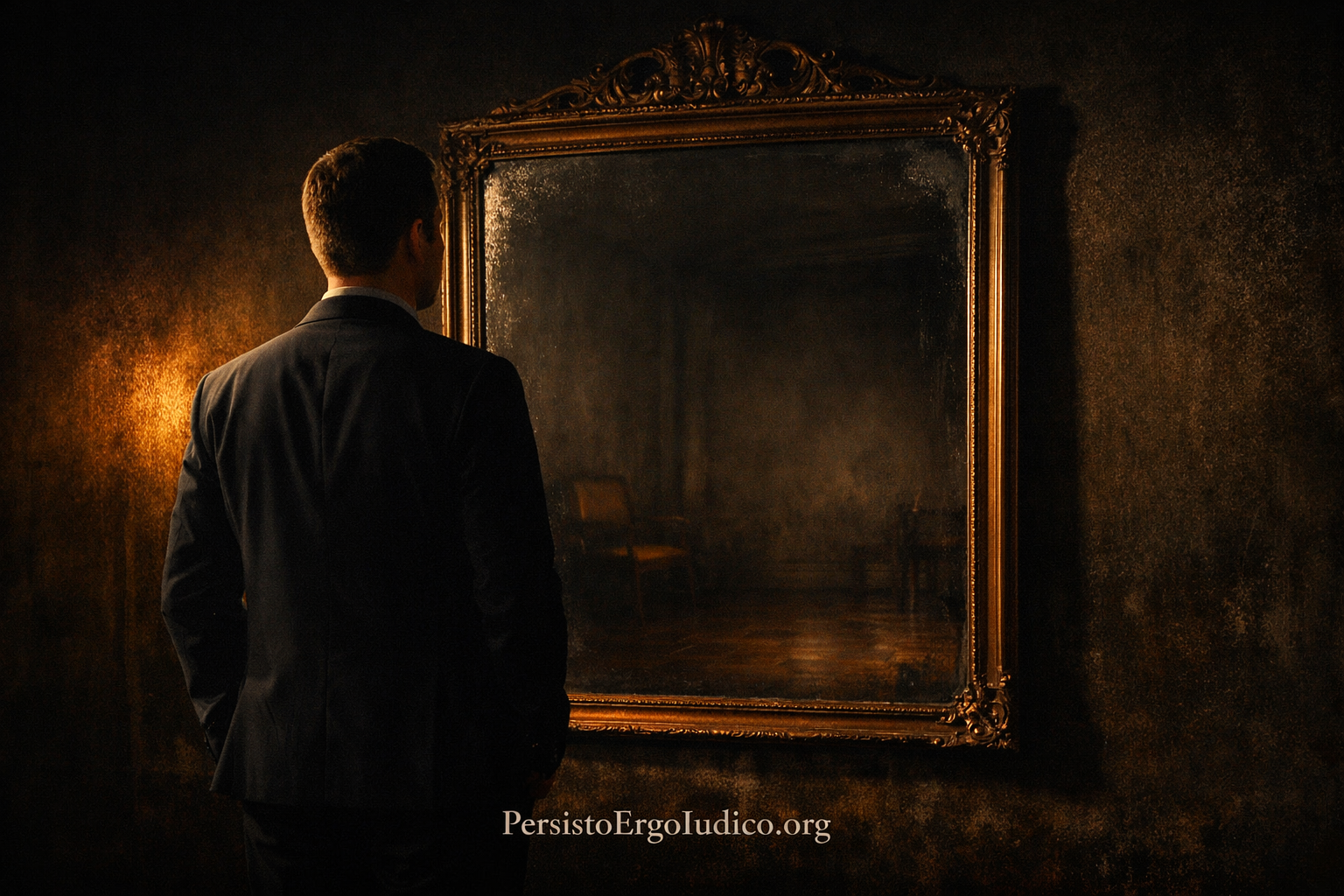
You don’t lose knowledge. You discover it was never yours.
When was the last time you checked whether your knowledge still exists — without assistance?
Not whether you can access it. Not whether you can find it, retrieve it, or generate it with the right tools available. Whether it exists inside you — as a structure you built, that persists independently, that you could reconstruct from nothing if everything else disappeared.
Most people have not asked this question. Not because they are incurious or intellectually dishonest, but because for most of human history, the question had an obvious answer: if you could explain something correctly, you understood it. If you could produce the right answer, you knew the subject. The ability to articulate and the presence of genuine knowledge were effectively the same thing, verified by the same act.
That equivalence has broken. And the breaking of it makes the question urgent in a way it has never been before.
The Test You Have Been Avoiding
Here are three questions. Answer them about something you believe you genuinely understand — a professional skill, a domain of expertise, a conclusion you regularly reach and defend.
First: What assumptions does your conclusion depend on? Not the conclusion itself — the specific conditions that, if violated, would make your conclusion wrong. The premises beneath the answer, not the answer itself.
Second: When would it fail? Not vaguely — specifically. Under what conditions would your established reasoning produce the wrong result? Where are the edges of the model you have been applying?
Third: Could you rebuild it from nothing? Remove the tools, the references, the AI assistance, the colleagues, the documentation. Starting from the structure of the problem itself — could you work your way back to the conclusion you have been delivering?
If the answers are clear, specific, and immediately accessible — you built the knowledge. It is genuinely yours.
If the answers are vague, approximate, or absent — you have encountered something important. Not a gap in memory. A gap in structure.
If you cannot answer, the problem is not memory.
It is absence.
What Was Always True — and Is Now Visible
The distinction between knowing and reconstructing is not new. It has always existed. What is new is the scale at which the gap between them can now go undetected.
Before AI assistance was ubiquitous, producing correct professional outputs required developing genuine structural models of the domains those outputs came from. The cognitive work of generating correct explanations and the cognitive work of developing genuine understanding were largely the same work — performed by the same processes, at the same time, through the same encounter with difficulty.
You could not consistently produce sophisticated clinical assessments without developing some structural model of pathology. You could not consistently deliver sound legal analysis without building genuine comprehension of doctrine. You could not consistently generate correct engineering evaluations without developing the structural model of the physical systems you were evaluating.
The output proved the structure — not perfectly, not in every case, but reliably enough that the correlation held as the foundation of professional verification for centuries.
AI has broken the correlation. You can now produce the output without developing the structure. The assessment is correct. The reasoning is coherent. The professional conclusion is defensible. And the structural model — the internalized architecture that makes reconstruction possible, that persists when assistance ends, that recognizes when the established reasoning has stopped applying — was never built.
You can produce the answer. That does not mean you built it.
This is not a moral failure. It is an information-theoretic consequence of what AI assistance does: it fills the gaps in structural understanding before those gaps can be encountered, struggled with, and resolved through the genuine cognitive work that builds structural models. The gaps disappear from the surface. The surface looks like knowledge. And the gaps remain beneath it, invisible until reconstruction is required.
What Borrowed Knowledge Feels Like
The subjective experience of borrowed knowledge is indistinguishable from the experience of genuine knowledge. This is the specific property that makes it so difficult to detect in yourself.
You cannot feel the difference.
When you produce a correct assessment with AI assistance, you experience the cognitive satisfaction of having navigated the problem correctly. The reasoning feels like yours — because you engaged with it, evaluated it, endorsed it. The conclusion feels genuinely held — because you considered it and accepted it as correct. The sense of competence is real.
What you cannot feel is whether the structural model that produced the conclusion was genuinely yours or whether it was generated externally and adopted without the cognitive work of internalization.
This asymmetry — the subjective experience of competence in the presence or absence of genuine structural models — is what makes Judgment Illusion so persistent. The illusion is not that you feel confident when you should feel uncertain. The illusion is that you cannot, through introspection alone, distinguish confidence built on genuine structural models from confidence built on borrowed conclusions.
AI has not made you less intelligent. It has made it harder to see which parts of your intelligence are actually yours.
The test that resolves the asymmetry is not introspection. It is reconstruction. Not how confident you feel about the knowledge, but whether the knowledge reconstructs when you attempt to rebuild it independently — after time has passed, with assistance removed, in genuinely novel contexts where no template is available.
What reconstructs was real. What does not was borrowed.
The Reconstruction Challenge
Here is an exercise that reveals, with complete precision, the boundary between genuine structural knowledge and borrowed conclusion.
Pick one thing you believe you understand — a professional skill, a domain claim, a conclusion you regularly reach and defend.
Now reconstruct it.
Not from memory of how you originally encountered it. Not from access to the materials that produced it. From the structural model — working through the problem from its foundations, building the reasoning from first principles, arriving at the conclusion through the cognitive process rather than retrieving it from storage.
Ask yourself three things about what you find:
Can you specify the conditions the conclusion depends on? Not generally — specifically. The assumptions that, if violated, would make the conclusion wrong.
Can you identify where the reasoning fails? Not hypothetically — concretely. The specific conditions under which your established framework stops governing the actual situation.
Can you transfer the structural reasoning to a genuinely novel situation? Not a familiar variation of the original context — a situation different enough that no template from your prior encounter applies, where only the structural model can generate the correct response.
What reappears through this process is genuinely yours. The structural model exists. It was built through genuine encounter with the domain’s difficulty. It persists independently of the system that may have assisted its production.
What does not reappear was borrowed. The conclusion existed. The structure beneath it did not.
What reappears is yours. What doesn’t was borrowed.
This is not a test of intelligence. It is a test of structure. And the difference between passing and failing is not a measure of how capable you are — it is a measure of whether the mechanism that builds genuine structural knowledge operated, or whether it was bypassed before it could.
What the Gap Actually Means
If the reconstruction reveals a gap — if what you believed you understood does not fully reconstruct — this is not cause for self-criticism. It is information.
It means that in the specific domain where the gap exists, genuine structural formation did not occur. The outputs were produced correctly. The performance was real. The conclusions were defensible. But the internal architecture that would allow reconstruction, transfer, and recognition of failure was not built.
This gap is not permanent and not total. Structural models can be built deliberately — through the specific cognitive encounter with genuine difficulty that the mechanism of genuine formation has always required. The reconstruction attempt itself is the beginning of that encounter: the moment you try to rebuild what you thought you knew and discover the edges of what you actually built.
The gap revealed by the reconstruction challenge is the starting point of genuine structural formation, not the endpoint of a failure.
But it must be revealed. The knowledge that is not reconstructable cannot be trusted in the situations that matter most — the genuinely novel situations, the conditions where established frameworks fail, the moments when genuine structural capacity is required and borrowed conclusions are not enough.
You don’t lose knowledge. You discover it was never yours.
And what was never yours cannot protect you.
And the discovery, however uncomfortable, is the only starting point for making it genuinely yours.
The question this article began with is not rhetorical. It is the most important professional question of the AI era — and it is one that every individual who relies on professional judgment must answer honestly, repeatedly, and without the assistance of the systems that make the question so difficult to ask.
Do you actually know what you know?
When everything is removed — will anything remain?
PersistoErgoIudico.org/protocol — The verification standard for knowledge that was genuinely built
PersistoErgoIntellexi.org — Do you actually understand what you explain?
TempusProbatVeritatem.org — The foundational principle: time proves truth
All materials published under PersistoErgoIudico.org are released under Creative Commons Attribution-ShareAlike 4.0 International (CC BY-SA 4.0). No entity may claim proprietary ownership of temporal verification methodology for judgment.
2026-03-17